Good Vibes Only: How Feel-Good Anime Is Quietly Healing the US Fandom Scene
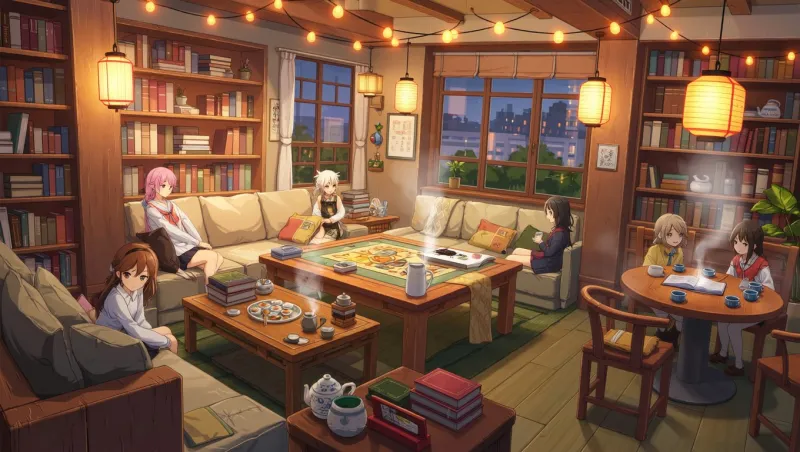
Photo: young diverse friends watching anime together cozy living room, via images.stockcake.com
Something kind of beautiful is happening in American anime fandom right now, and honestly, it doesn't get nearly enough attention. While the internet keeps feeding us takes about gatekeeping, discourse wars, and which shonen series has the most toxic Reddit thread, a quieter revolution is unfolding — one centered entirely around joy.
A growing slice of Gen Z anime fans in the US is actively choosing feel-good, low-stakes, community-first anime over the high-octane, fanservice-heavy titles that have long dominated Western streaming charts. And the shows leading this shift? Think Kemono Friends, Nichijou, A Place Further Than the Universe, and Yuru Camp. Cute, warm, sometimes weird — and absolutely zero interest in making you feel bad about yourself for watching them.
So What's Actually Going On?
To understand this movement, you have to understand what these fans are reacting against. Western anime fandom has had a rough reputation for a while. Newcomers get quizzed on their credentials. Women and LGBTQ+ fans get talked over. Discourse around popular series can spiral into something genuinely exhausting within 48 hours of a new episode dropping.
For a lot of younger fans, that environment just isn't worth it. TikTok creator and self-described "cozy anime girlie" Maya T., who runs a small but devoted anime lifestyle account out of Portland, Oregon, put it plainly in a recent video that racked up over 200,000 views: "I got into anime because it made me feel something good. I'm not here to prove anything to anyone."
Her comment section? Thousands of people saying exactly the same thing.
Kemono Friends and the Philosophy of Gentle Wonder
If there's a mascot for this movement, it might just be Kemono Friends — a 2017 anime that, on paper, sounds like it shouldn't work at all. The CGI is rough. The premise (anthropomorphized animal girls living in a post-apocalyptic wildlife park) is bizarre. And yet it developed one of the most earnest, low-drama fan communities in recent anime history.
What Kemono Friends offered wasn't spectacle. It offered sincerity. The characters are endlessly curious about the world around them. They help each other without ulterior motives. The show asks almost nothing of the viewer except that they show up and enjoy something gentle for twenty minutes.
For fans burned out on power-scaling debates and "best girl" wars, that was genuinely radical.
Discord communities built around the show have become known for their unusually welcoming culture. New members get greeted. Fan art gets celebrated regardless of skill level. The vibe, multiple members describe, feels less like a fandom and more like a club that just really likes animals and kindness.
Nichijou's Chaos and A Place Further Than the Universe's Heart
Not every wholesome anime takes the soft-and-slow approach, though. Nichijou — KyoAni's gloriously unhinged slice-of-life comedy — has been finding new American audiences years after its 2011 release, largely through short clip compilations on YouTube and TikTok. The show is loud, absurd, and completely uninterested in making sense. But it's also completely free of mean-spiritedness. Nobody loses. Nobody gets humiliated. The humor comes from shared weirdness, not cruelty.
Then there's A Place Further Than the Universe (Sora yori mo Tooi Basho), which might be the most emotionally sophisticated entry in this wave. The story follows four teenage girls who travel to Antarctica together, and it handles themes of grief, friendship, and self-discovery with a maturity that catches a lot of viewers off guard. Fan communities around this show tend to run deep — people don't just like it, they treasure it.
What these shows share isn't a genre or an aesthetic. It's an attitude. They trust the audience to find meaning without being manipulated into it.
Streamers Are Noticing
The shift is showing up in streaming culture too. A handful of Twitch and YouTube streamers have built dedicated audiences specifically around "cozy anime" watch-alongs — long, relaxed streams where chat is encouraged to be kind and newcomer questions are welcomed rather than mocked.
Streamer duo based out of Austin, Texas, who go by the handle SoftSubbed, started hosting weekly Yuru Camp watch-alongs last year almost as a joke. "We just wanted a chill stream," one of them explained in a community post. "We did not expect 800 people to show up every week and genuinely be nice to each other the entire time."
They've since expanded to a full schedule of wholesome anime streams, with community guidelines that are refreshingly simple: be curious, be kind, don't gatekeep.
What This Means for Anime's American Future
It would be easy to dismiss this as a niche trend — a small corner of fandom doing its own thing while the mainstream keeps watching Demon Slayer. But the numbers suggest something more significant. Streaming platforms have quietly noted increases in completion rates for "iyashikei" (healing-style) anime among US audiences aged 18-24. Yuru Camp and Non Non Biyori have both seen notable bumps in American viewership over the past two years, driven almost entirely by word-of-mouth recommendations in spaces that prioritize welcoming energy.
There's also something worth noting about who is leading this movement. A disproportionate number of the fans, streamers, and community builders championing wholesome anime are women, LGBTQ+ fans, and people of color — groups that have historically had the roughest time in mainstream Western anime spaces. That's not a coincidence. When you build a community around gentleness, you tend to attract people who've been starved of it.
The Bigger Picture
Japanese anime has always been more diverse in tone and intention than its loudest Western ambassadors have made it seem. For every hyperstimulating action series, there are dozens of quiet, thoughtful stories about everyday life, friendship, and finding beauty in small things. American audiences are finally discovering that breadth — and building communities worthy of it.
The rise of wholesome anime culture in the US isn't just a fandom trend. It's a values statement. Gen Z fans are saying, pretty clearly, that they want spaces where curiosity is celebrated, where nobody has to earn their seat at the table, and where the whole point is just to feel good together.
Honestly? That sounds like exactly the kind of fandom Japan's best storytellers have been building toward all along.