Lofi Wasn't Enough: How Tokyo's Underground Producers Became Gen Z's Most-Played Secret
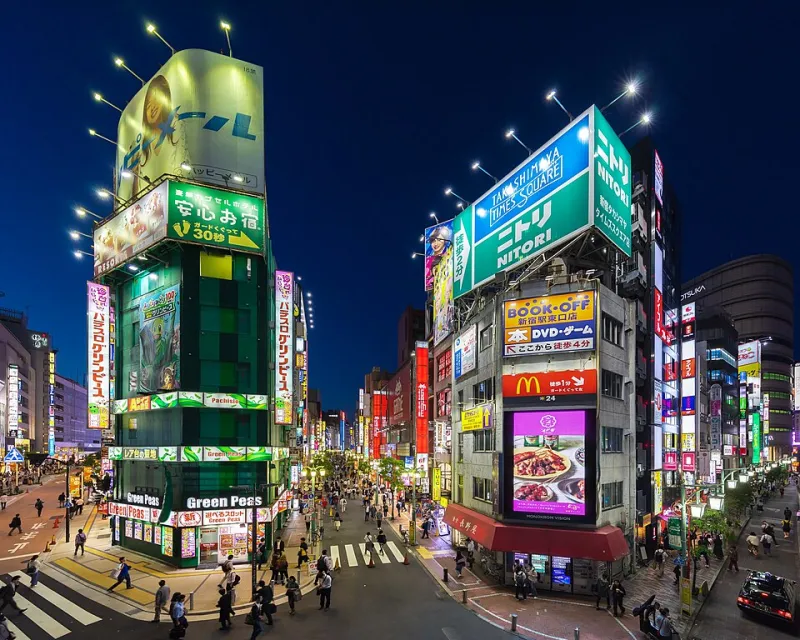
Photo: Basile Morin, CC BY-SA 4.0, via Wikimedia Commons
Open TikTok on any given Tuesday and scroll for five minutes. Somewhere in that feed, there's a video with a washed-out aesthetic, slow-motion footage of neon-lit streets or convenience store aisles, and a track underneath that sounds like it was recorded in 1984 and then left in a warm room for forty years. That track? There's a decent chance it came from a producer in Tokyo who has fewer than 10,000 followers and releases music almost entirely through Bandcamp.
This is the quiet, almost accidental takeover of American Gen Z's ears by Japanese underground music — and it's one of the more fascinating cultural crossovers happening in pop right now.
A Sound That Feels Like a Memory You Never Had
To talk about why Japanese underground music resonates so deeply with American listeners, you have to talk about the feeling it produces. Vaporwave, city pop revivals, ambient electronic, environmental music — these genres share a quality that's hard to pin down but instantly recognizable. They feel nostalgic for something you can't quite name. Wistful for a time and place that may not have existed exactly as you're imagining it.
For American Gen Z — raised on algorithmic feeds, content saturation, and the relentless churn of trend cycles — that feeling is almost shockingly rare. And they are hungry for it.
City pop, the breezy, funk-inflected Japanese pop genre that peaked in the late '70s and '80s, was arguably the first crack in the dam. Mariya Takeuchi's "Plastic Love" became a genuine YouTube phenomenon around 2018, racking up tens of millions of views on a decades-old track that had never been officially released internationally. That moment signaled something: American audiences weren't just curious about Japanese music history. They were ready to fall in love with it.
From Takeuchi to Bandcamp: The Underground Pipeline
What happened after the city pop boom is where the story gets really interesting. The viral moment didn't just send people back to the '80s — it sent them forward, into the communities of contemporary Japanese producers who had been quietly building on those sounds for years.
Artists like Ichiko Aoba, Soichi Terada, and a constellation of Bandcamp-native vaporwave producers started appearing in the playlists and video descriptions of American creators who had gone down the city pop rabbit hole. The discovery pipeline was almost entirely organic: one recommendation leading to another, SoundCloud comment sections functioning as informal record stores, Reddit threads on r/japanesemusic becoming surprisingly influential tastemaker spaces.
None of this was orchestrated by labels or PR campaigns. It was pure word-of-mouth, accelerated by the architecture of short-form video.
TikTok as an Unlikely A&R Department
TikTok's role in this story can't be overstated, but it works differently than you might expect. The platform didn't create the interest in Japanese underground music — it amplified a discovery process that was already happening in more niche corners of the internet. What TikTok did was give American creators a canvas where that music could be heard by millions of people in the context of visuals that matched its mood perfectly.
The aesthetic language of Japanese underground music — its relationship to urban loneliness, to the beauty of mundane spaces, to a certain quality of late-night light — translates into video almost automatically. Creators don't have to explain anything. They just let the track play under footage of rain-slicked streets or a convenience store at 2 a.m., and the feeling does all the work.
Music journalist and TikTok creator Dani R., based in Chicago, has been documenting this crossover for the past two years on her channel, which focuses on "music that shouldn't be this good." "What I find wild," she said in a recent video, "is that these Japanese producers aren't making music for TikTok. They're not even thinking about American audiences most of the time. But the music fits the platform like it was designed for it."
The Authenticity Factor
There's a deeper reason this music resonates beyond pure aesthetics, and it connects to something Gen Z talks about constantly: authenticity. Western mainstream pop has never been more polished, more data-optimized, more carefully engineered to hit emotional triggers. And for a lot of younger listeners, that precision has started to feel hollow.
Japanese underground producers, by contrast, are largely making music for the love of it — releasing on platforms with no major label infrastructure, pricing albums at whatever-you-want on Bandcamp, communicating with fans in broken English and occasional Japanese that nobody bothers to translate. There's a rawness to the whole ecosystem that feels genuinely countercultural in 2024.
It's not that these artists are trying to seem authentic. They just are, because they're operating completely outside the systems designed to manufacture that quality.
Remixing and Recontextualizing
American creators aren't passive consumers in this exchange, either. One of the more fascinating dynamics in this scene is the way US-based producers and beatmakers have started incorporating Japanese underground sounds into their own work — sampling city pop basslines, building on ambient textures from Tokyo artists, creating a kind of transatlantic dialogue that neither side necessarily planned.
Vaporwave as a genre is itself largely an American invention built from Japanese source material, and that tradition continues in newer, more nuanced forms. There are producers in Brooklyn and Los Angeles making music that is genuinely indistinguishable from what's coming out of Tokyo's underground scene — and Tokyo producers who have started incorporating influences flowing back the other direction.
What It Means Beyond the Playlist
It would be easy to frame all of this as just another aesthetic trend — a vibe, a phase, something Gen Z will move past when the algorithm serves them the next thing. But there's evidence it runs deeper than that.
The communities that have formed around Japanese underground music in the US are notably invested. They learn artist names. They seek out interviews and documentaries. They spend actual money on Bandcamp on a Friday, which if you know anything about streaming economics, is genuinely radical behavior for a generation that grew up expecting music to be free.
Some fans have started learning Japanese specifically to engage more directly with the music and the culture around it. Others have booked trips to Tokyo with the explicit goal of visiting the record stores and live venues tied to the scenes they've been following online.
This isn't passive consumption. It's the beginning of something that looks a lot like genuine cultural exchange — messy, imperfect, driven by feeling rather than strategy, and maybe exactly what both sides needed.
Tokyo's underground didn't come looking for American fans. But it found them anyway, one late-night scroll at a time.